ApexGrid
F1 Race Ticket Reservation & Microservices Platform
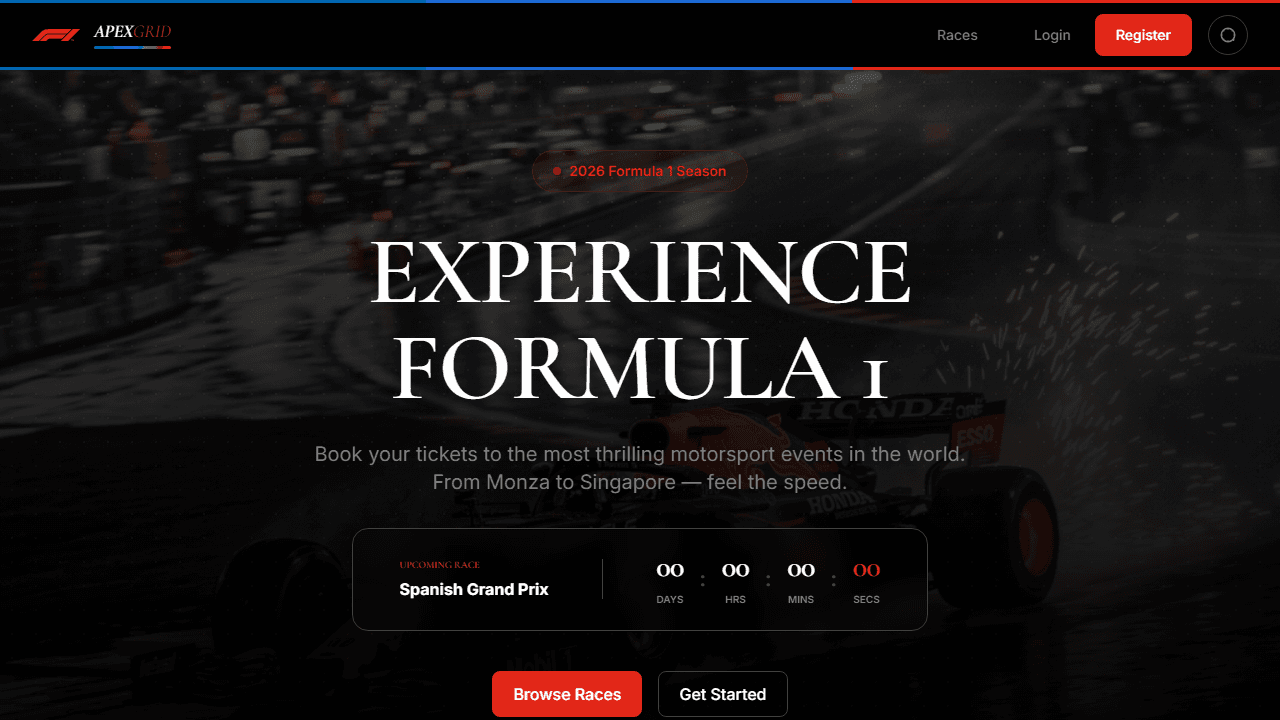
My contribution
Developed the gateway, user and race-ticket services, authentication flows, reservation logic and React admin interface.
Engineering decisions
- Route client requests through Spring Cloud Gateway to centralize entry to the user and race services.
- Use PostgreSQL inventory triggers and a reservation-expiry worker to keep booking state and ticket availability coordinated.
Testing & evidence
- The repository contains 3 service responsibilities: gateway, users and race-ticket reservations.
- Reservations expire after 30 minutes; the worker releases expired bookings.
- JWT and role-based authorization distinguish user and admin flows.
Current limitations & next steps
Gateway latency and production concurrency have not been substantiated with a benchmark here. Service boundaries demonstrate the architecture, not an availability guarantee.
The problem it solves
Race-ticket reservation project with 3 Spring Boot services (API Gateway, User Service, Race Service) connected through Spring Cloud Gateway. Ticket inventory uses PostgreSQL database triggers and a 30-minute reservation-expiry scheduler. JWT and role-based access control protect user/admin flows; Swagger UI documents the API, and database views support an admin analytics panel.
How it works
Distributed microservices system with PostgreSQL inventory triggers, reservation expiry and centralized JWT gateway validation.
- 01
React 18 Glassmorphic UI Client
- 02
Spring Cloud Gateway (Centralized Routing & JWT Filter)
- 03
Microservices (User Service / Race Ticket Service)
- 04
PostgreSQL DB Triggers & 30-Min Auto-Expiry Scheduler
Handles centralized routing, rate limiting, and RBAC token evaluation.
Ticket booking service powered by PostgreSQL triggers for real-time inventory management.
Complex PostgreSQL DB views feed real-time sales and reservation metrics to the React Admin Panel.
StudyMate AI
Intelligent RAG-Based Educational Knowledge Assistant